Tulips.
This is a kami-fuusen (紙風船, Japanese blow-up paper balloon), with motifs of Toyama on it. There is a city in Toyama called Tonami, and they have a tulip park which hosts a Tulip Fair every year (around end April~early May). But I went in late-July so sadly I never got to see it...


The different views of Ainokura with the changing seasons (taken from a pamphlet since obviously I was not there for all!)


 I suppose the best times to go would be when the snow wall is still around or during autumn, when the changing colors of the leaves over the entire mountain range gives a spectacular sight. Visitors get a special "Visitor's Certificate" with 3 postcards!


 Last year was the 40th anniversary, so there were special stamps at various locations along the route. This huuuge stamp was one of them, and I stamped it into my passport as a souvenir :)

"Toyama: Where Japan goes to relax!"
Toyama's tourism slogan.
When I arrived at immigration at Nagoya's Chubu International Airport, in my immigration form I put the address of the hotel I was going to be staying in at Toyama, and the immigration officer spent a good few minutes questioning me as to what I would be doing in Toyama^^ He commented that it was unusual as not very many international tourists head there. But it really is relaxing; away from the hustle and bustle of a densely populated city.

Plastic bag with images of Toyama.

Toyama-limited Hello Kitty handkerchief~!

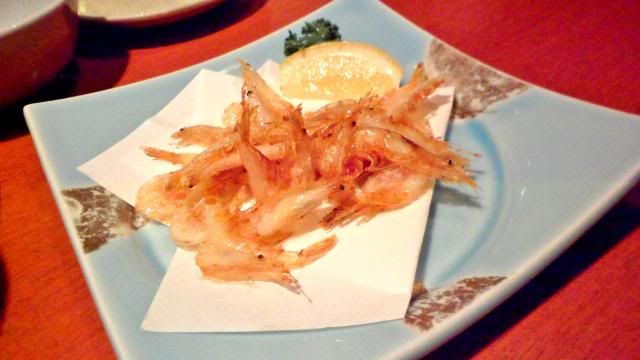
Yellowtail. White Shrimp. Firefly Squid.
Toyama is a prefecture located along the coast of the Sea of Japan, so much of their famous foods is seafood! Seafood like yellowtail, white shrimp (shiro-ebi), firefly squid (hotaru-ika).
I would have loved to try the hotaru-ika, squid is one of my absolute favorite foods!

Kurobe Gorge Toroko Train.
I didn't get to visit this due to time constraints, but it does look lovely.


Pictures of the bridge on Kurobe Gorge, the red is such a striking color.
Right now I'm doing a civil engineering internship,
so I have deepened my fascination with bridges and their structures O_o

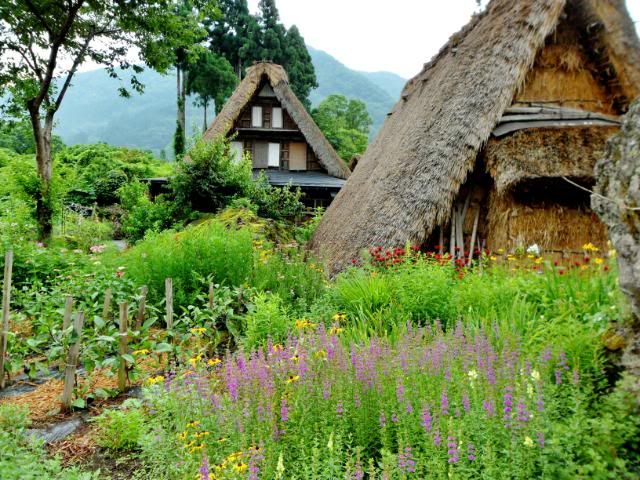
A World Heritage Site for the traditional Gassho-zukuri houses.
To see gassho-zukuri houses, most people visit Shirakawa-go in the Gifu prefecture instead as it is more accessible, especially for non-Japanese speakers. I chose to go to Gokayama as it was more "along the route" for my itinerary, plus I had read reviews that Ainokura (a village in Gokayama) was the most picturesque of the 3 World Heritage Site gassho-zukuri villages. (The three being Ogimachi in Shirakawa-go; and Ainokura and Suganuma in Gokayama.)

When I went there I bought some postcard sets from the little store near the village entrance.

The first set was pictures with captions, many of the pictures have a rustic, carefree air.

The second set was a bunch of sketches of the gassho-zukuri houses. The sketches are really good!

Pamphlet on Gokayama.
Not many foreign visitors go there cos it's rather inaccessible...but it's an extremely scenic place.
Amidst flowers and high grasses, the houses look like fairytale cottages!

Cherry blossoms in spring

Abundant greenery in summer

Gorgeous changing of colors in autumn

Blanketed by snow in winter

For an enhanced experience you can actually stay overnight at a residence.
It is kind of pricey and hard to arrange, but it would be a great way to fully experience the gassho-zukuri houses.

Information on the roof, which they replace every 10 years.

This was the place I wanted to go to...but couldn't access,
and thus ended up having to walk 2km uphill in the rain in the middle of the remote, deserted mountain.
I got these brochures from the store by the bus stop...where the bus comes every 4 hours.

It's the Washi-no-sato (和紙の里, Japanese paper village).

There you can experience making your own Japanese paper (washi) items!

Making 3 postcards (hagaki) will take around 20min and costs 500yen.
Making 2 bookmarks (shiori) will take around 15min and costs 300yen.

Making a whole large sheet (30cm x 45cm) of paper will take around 20min and costs 500yen.
Making a Japanese fan (uchiwa) will take around 20min and costs1,200yen.

The snow walls at the Tateyema Kurobe Alpine Route.
The walls are best seen in around April~May. Maybe even June. But by July (when I went) they're little tiny flat things that hardly resemble the high walls they once were! :(

Still have my ticket from that day.
 I suppose the best times to go would be when the snow wall is still around or during autumn, when the changing colors of the leaves over the entire mountain range gives a spectacular sight. Visitors get a special "Visitor's Certificate" with 3 postcards!
One of the snow wall.
Someday I'm going to go back to the Tateyama Kurobe Alpine Route just to experience seeing this high wall of snow...and also to go hiking at the mountain-top! The day I went was too cloudy and all the views were obstructed :(

One of the valley.
This picture makes me want to go back again during autumn to see the changing leaves and snow-capped mountains!

And one of the dam.
Normally, on days with good weather you can see rainbows appearing near the discharge.
However on the day I went the weather was bad, so no rainbows...

I ended up buying the pictorial book, it has lots of pretty pictures of the mountain!

Shoumyou-daki, the highest waterfall in Japan at 350m.

Scenery riding the bus up the mountain.
 Last year was the 40th anniversary, so there were special stamps at various locations along the route. This huuuge stamp was one of them, and I stamped it into my passport as a souvenir :)
Living in an urban city with a year-long tropical climate, I love travelling to see nature: vast expanses of greenery, flowers, blue oceans; high mountains, volcanoes and waterfalls; clear, flowing rivers etc. Looking at natural scenery and pristine nature makes me feel calm, relaxed and at peace.